Where Does Your Time Go? A Founder FSO's Guide to Managing Industrial Security Compliance
Published by FCL Simple
Executive Summary
For most small and mid-sized defense contractors, the FSO role doesn't belong to a dedicated security professional. It belongs to the founder, an executive, or an operations leader who wears the FSO hat alongside everything else they do.
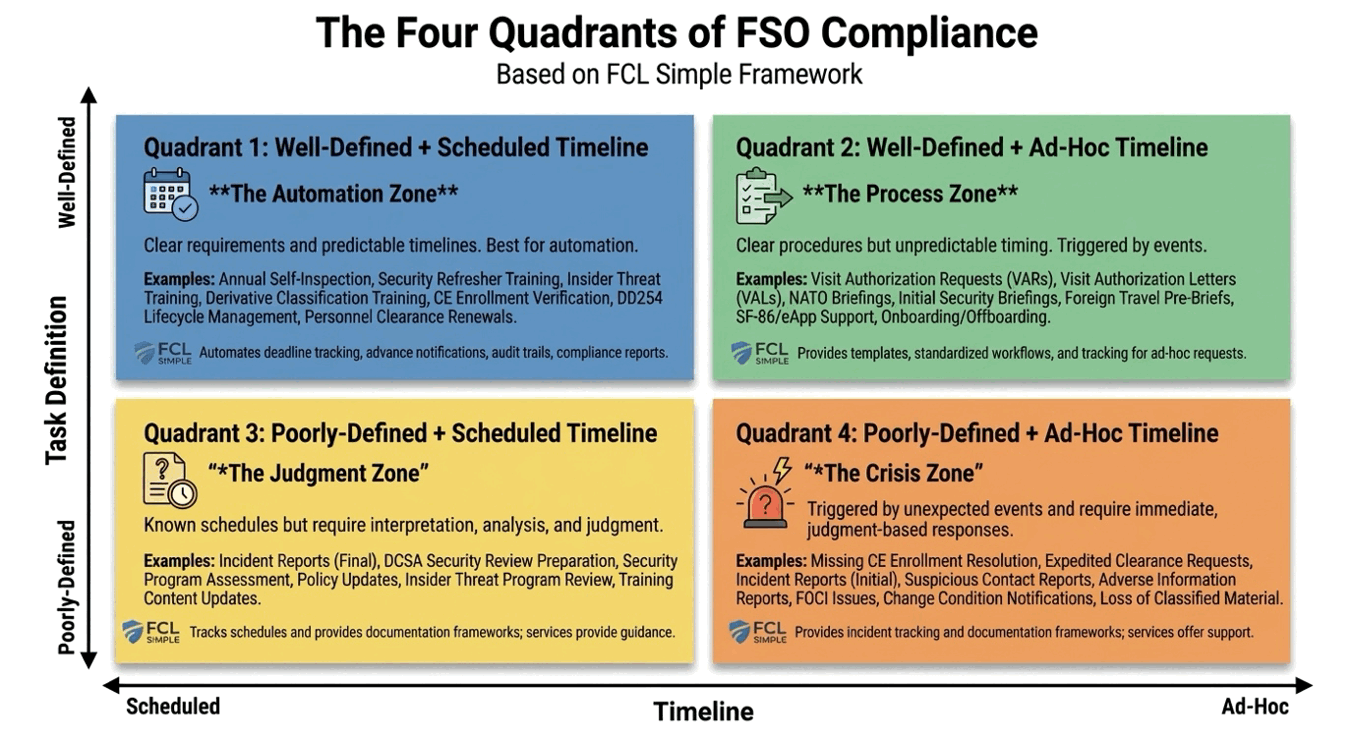
This white paper introduces a framework for understanding where your time actually goes. By categorizing compliance activities along two dimensions (definition clarity and timeline predictability) we can identify which tasks are prime candidates for automation and which require human judgment and flexibility.
Understanding this framework is the first step toward reclaiming your time for the work that matters: growing your business, winning contracts, and making the strategic security decisions that protect your facility clearance.
The Founder FSO Reality
When the Department of Defense estimated compliance costs for the NISPOM rule in 2020, they calculated that an FSO at a small business entity would need 10 hours in the first year just to become familiar with the regulations, followed by 2-5 hours annually for ongoing familiarization. That's just the baseline. It doesn't account for the actual work of running a security program.
The reality for founder FSOs is far more demanding. A typical facility security program involves:
- Managing personnel security clearances across your workforce
- Processing DD254 contracts and tracking classification requirements
- Conducting annual self-inspections and preparing for DCSA security reviews
- Delivering initial and annual refresher training to all cleared employees
- Processing visit authorization requests for employees visiting other facilities
- Reporting incidents, adverse information, and suspicious contacts
- Managing foreign travel notifications and post-travel debriefs
- Tracking continuous evaluation enrollment for all clearance holders
- Responding to change conditions (address changes, KMP changes, ownership changes)
- Maintaining insider threat program documentation
For a dedicated FSO, these tasks constitute a full-time job. For a founder FSO, they represent hours stolen from product development, customer relationships, business development, and strategic planning.
The question isn't whether these tasks need to be done. They do. The question is: which tasks require your personal attention, and which can be automated, delegated, or systematized?The Compliance Activity Framework
Not all FSO tasks are created equal. Some are clearly defined by regulation with predictable timelines. Others are vaguely specified and triggered by unpredictable events. Understanding where each task falls helps you decide how to handle it.
We categorize compliance activities along two dimensions:
Dimension 1: Task Definition
Well-Defined Tasks have clear regulatory requirements, specific procedures, and objective success criteria. You know exactly what needs to be done and how to do it correctly.
Poorly-Defined Tasks involve judgment calls, interpretation, and situational awareness. The regulations provide guidance, but execution depends on circumstances.
Dimension 2: Timeline Predictability
Scheduled Tasks occur on predictable timelines: annually, upon hire, upon contract award, or at other knowable intervals.
Ad-Hoc Tasks are triggered by events outside your control: employee actions, customer requests, government communications, or security incidents.
The Four Quadrants of FSO Compliance
Quadrant 1: Well-Defined + Scheduled Timeline
The Automation Zone
These tasks have clear requirements and predictable timelines. They're the best candidates for software automation because the rules are known and the timing is fixed.
| Activity | Frequency | Time Investment | Automation |
|---|---|---|---|
| Annual Self-Inspection | Yearly | 8-20 hours | High |
| Security Refresher Training | Every 12 months | 1-2 hrs/employee | High |
| Insider Threat Training | Annual | 1 hr/employee | High |
| Derivative Classification Training | Every 2 years | 1-2 hrs/employee | High |
| CE Enrollment Verification | Ongoing | 2-4 hrs/month | High |
| DD254 Lifecycle Management | Per contract | 2-4 hrs/contract | High |
| Personnel Clearance Renewals | 5/6/10 year cycles | 4-8 hrs/person | High |
What FCL Simple Does: Automates deadline tracking, sends advance notifications, maintains audit trails, and generates compliance reports. You spend minutes reviewing dashboards instead of hours maintaining spreadsheets.
Quadrant 2: Well-Defined + Ad-Hoc Timeline
The Process Zone
These tasks have clear procedures but unpredictable timing. They're triggered by specific events: a new hire, a customer visit request, a contract award. The key is having efficient processes ready to execute when needed.
| Activity | Trigger | Time Investment | Process Potential |
|---|---|---|---|
| Visit Authorization Requests (VARs) | Customer/employee request | 30-60 min each | High |
| Visit Authorization Letters (VALs) | Incoming visit requests | 15-30 min each | High |
| NATO Briefings | Contract requirement | 1-2 hrs/person | Medium |
| Initial Security Briefings | New cleared employee | 1-2 hrs/person | High |
| Foreign Travel Pre-Briefs | Employee travel notification | 30-60 min each | High |
| SF-86/eApp Support | New clearance or renewal | 2-4 hrs/person | Medium |
| Onboarding/Offboarding | Employment changes | 1-2 hrs/person | High |
What FCL Simple Does: Provides templates, standardized workflows, and tracking for ad-hoc requests. When a VAR comes in, you execute a proven process rather than reinventing it each time.
Quadrant 3: Poorly-Defined + Scheduled Timeline
The Judgment Zone
These tasks occur on known schedules but require interpretation, analysis, and professional judgment. Software can remind you they're due, but a human must decide how to execute them.
This is where incident reports live. The NISPOM is clear on timing: initial reports must be submitted promptly, and final reports are due within 30 days of the initial report. But what constitutes a reportable incident? What level of detail is required? What remediation is appropriate? Those questions require judgment.
| Activity | Timeline | Time Investment | Why Judgment Required |
|---|---|---|---|
| Incident Reports (Final) | 30 days from initial | 4-8+ hours | Scope, investigation, remediation |
| DCSA Security Review Prep | As scheduled by ISR | 20-40 hours | Interpreting feedback, priorities |
| Security Program Assessment | Annual | 10-20 hours | Evaluating effectiveness |
| Policy Updates | Annual review | 4-8 hours | Adapting to changes, threats |
| Insider Threat Program Review | Annual | 4-8 hours | Assessing adequacy |
| Training Content Updates | Annual | 2-4 hours | Relevance to operations |
What FCL Simple Does: Tracks schedules and provides documentation frameworks, but recognizes that these tasks benefit from human expertise. For founder FSOs who want support, FCL Simple's AFSO services provide experienced professionals to guide these judgment-based activities.
Quadrant 4: Poorly-Defined + Ad-Hoc Timeline
The Crisis Zone
These tasks are triggered by unexpected events and require immediate, judgment-based responses. They're the hardest to plan for and often the most stressful for founder FSOs.
Missing CE enrollment is a perfect example. You run a DISS report and discover that three employees aren't enrolled in Continuous Evaluation. Why? Could be a DCSA system glitch. Could be a data entry error. Could be something you need to fix on your end. There's no clear playbook, and you need to figure it out now because it's a compliance gap.
| Activity | Trigger | Time Investment | Challenge |
|---|---|---|---|
| Missing CE Enrollment Resolution | DISS report shows gaps | 2-4 hrs/case | Diagnosing cause |
| Expedited Clearance Requests | Customer/contract pressure | 4-8+ hours | Navigating DCSA |
| Incident Reports (Initial) | Violation discovered | 2-4 hours | What's reportable? |
| Suspicious Contact Reports | Employee reports contact | 2-4 hours | Assessing significance |
| Adverse Information Reports | Credible info received | 2-4 hours | Credibility assessment |
| FOCI Issues | Ownership changes | 10-40+ hours | Complex mitigation |
| Change Condition Notifications | KMP/address/structure | 2-8 hours | What's reportable? |
| Loss of Classified Material | Discovery of loss | 10-40+ hours | Full investigation |
What FCL Simple Does: Provides incident tracking and documentation frameworks. For serious incidents, FCL Simple's AFSO services offer experienced support to navigate complex reporting requirements and DCSA interactions.
Where Founder FSO Time Actually Goes
Based on industry research and FSO surveys, here's how a typical founder FSO's compliance time breaks down:
Without Automation or Support
| Category | Monthly Hours | Annual Hours | % of Time |
|---|---|---|---|
| Well-Defined + Scheduled | 8-12 | 96-144 | 35-40% |
| Well-Defined + Ad-Hoc | 6-10 | 72-120 | 25-30% |
| Poorly-Defined + Scheduled | 4-6 | 48-72 | 15-20% |
| Poorly-Defined + Ad-Hoc | 3-6 | 36-72 | 10-20% |
| TOTAL | 21-34 | 252-408 | 100% |
For a founder FSO, that's 250-400+ hours per year. The equivalent of 6-10 full work weeks spent on compliance activities rather than growing the business.
With FCL Simple Platform
| Category | Monthly Hours | Time Saved | How |
|---|---|---|---|
| Well-Defined + Scheduled | 2-4 | 60-75% | Automated tracking |
| Well-Defined + Ad-Hoc | 4-6 | 30-40% | Templates, workflows |
| Poorly-Defined + Scheduled | 4-6 | 0-10% | Better documentation |
| Poorly-Defined + Ad-Hoc | 3-6 | 0-10% | Better tracking |
| TOTAL | 13-22 | 35-45% |
Result: Founder FSOs reclaim 100-150+ hours annually with software automation alone.
Three Paths Forward: Choose Your Model
FCL Simple was designed with founder FSOs in mind. We recognize that you need flexibility to scale your security program based on your evolving needs and resources.
Option 1: Software Only
For: Founder FSOs who want to stay hands-on but need better tools
What You Get:
- FCL Simple platform with automated tracking and notifications
- DISS import/export for personnel clearance data
- DD254 management and contract tracking
- Training certification tracking with advance alerts
- Employee self-service portal
- Audit-ready reports and documentation
Time Investment: 13-22 hours/month (vs. 21-34 without automation)
Best For: Founders who enjoy the FSO role, have relatively stable compliance loads, and prefer direct control over their security program.
Option 2: Bring Your Own AFSO
For: Founder FSOs who have an existing relationship with an FSO consultant
What You Get:
- Full FCL Simple platform
- Multi-user access for you and your AFSO consultant
- Shared visibility into compliance status
- Collaborative workflow tools
- Single source of truth for security program documentation
Time Investment: 7-15 hours/month (oversight + strategic decisions)
Best For: Founders who already work with an FSO consultant and want a shared platform for better coordination and visibility.
Option 3: FCL Simple AFSO Services
For: Founder FSOs who want to offload security operations entirely
What You Get:
- Full FCL Simple platform
- Dedicated AFSO from FCL Simple's team
- Day-to-day security program management
- Clearance processing and DISS administration
- Training coordination and delivery support
- DCSA security review preparation
- Incident response support
Time Investment: 7-12 hours/month (oversight + critical decisions)
Best For: Founders who want to minimize time spent on security operations, are experiencing rapid growth, or need experienced support for complex situations.
Conclusion
Founder FSOs face an impossible math problem: the same NISPOM requirements that apply to companies with dedicated security staff also apply to you. But you're also running a business, managing employees, winning contracts, and serving customers.
The solution isn't to work harder. It's to work smarter by:
- Automating the well-defined, scheduled tasks that consume your time without requiring your judgment
- Systematizing the well-defined, ad-hoc tasks with templates and workflows
- Focusing your personal attention on the judgment-based activities that actually need your expertise
- Getting support for crisis situations that exceed your bandwidth or experience
FCL Simple was built by people who've lived the founder FSO experience. We built the tool we wished we had. And we designed it to scale with you from startup to established contractor.
Reclaim your time
Your time is your most valuable asset. Stop spending it on spreadsheets.
FCL Simple helps founder FSOs stay audit-ready without living in folders, calendars, and reminders.
Appendix: Key NISPOM Compliance Activities Reference
Scheduled Requirements
| Activity | Regulatory Basis | Frequency |
|---|---|---|
| Self-Inspection | 32 CFR 117.6(b) | Annual minimum |
| Security Refresher Training | 32 CFR 117.12(k) | Every 12 months |
| Insider Threat Training | 32 CFR 117.12(g)(2) | Annual |
| Derivative Classification Training | 32 CFR 117.12(h)(2) | Every 2 years |
| DCSA Security Review | Risk-based scheduling | As scheduled by ISR |
| Incident Report (Final) | 32 CFR 117.8(c) | Within 30 days of initial |
Ad-Hoc Requirements
| Activity | Regulatory Basis | Trigger |
|---|---|---|
| Adverse Information Reporting | 32 CFR 117.8 | Credible info received |
| Suspicious Contact Reporting | 32 CFR 117.8(a) | Potential intel interest |
| Foreign Travel Reporting | SEAD 3 | Pre/post travel |
| Change Condition Reporting | 32 CFR 117.8 | KMP/address/ownership |
| Incident Reporting (Initial) | 32 CFR 117.8(c) | Violations, loss |
| Visit Authorization | 32 CFR 117.16 | Classified visits |
© 2024 FCL Simple. All rights reserved.
FCL Simple is built by FSOs, for FSOs.